Your whole trial file in one place. Ready to prepare.
TrialLift helps trial lawyers prepare for trial. It brings every file for a case into one place, lets you ask questions and get summaries that point to the page, and opens a Canvas where you build the trial. Predictive analysis shows where the case is strong and where it is weak.
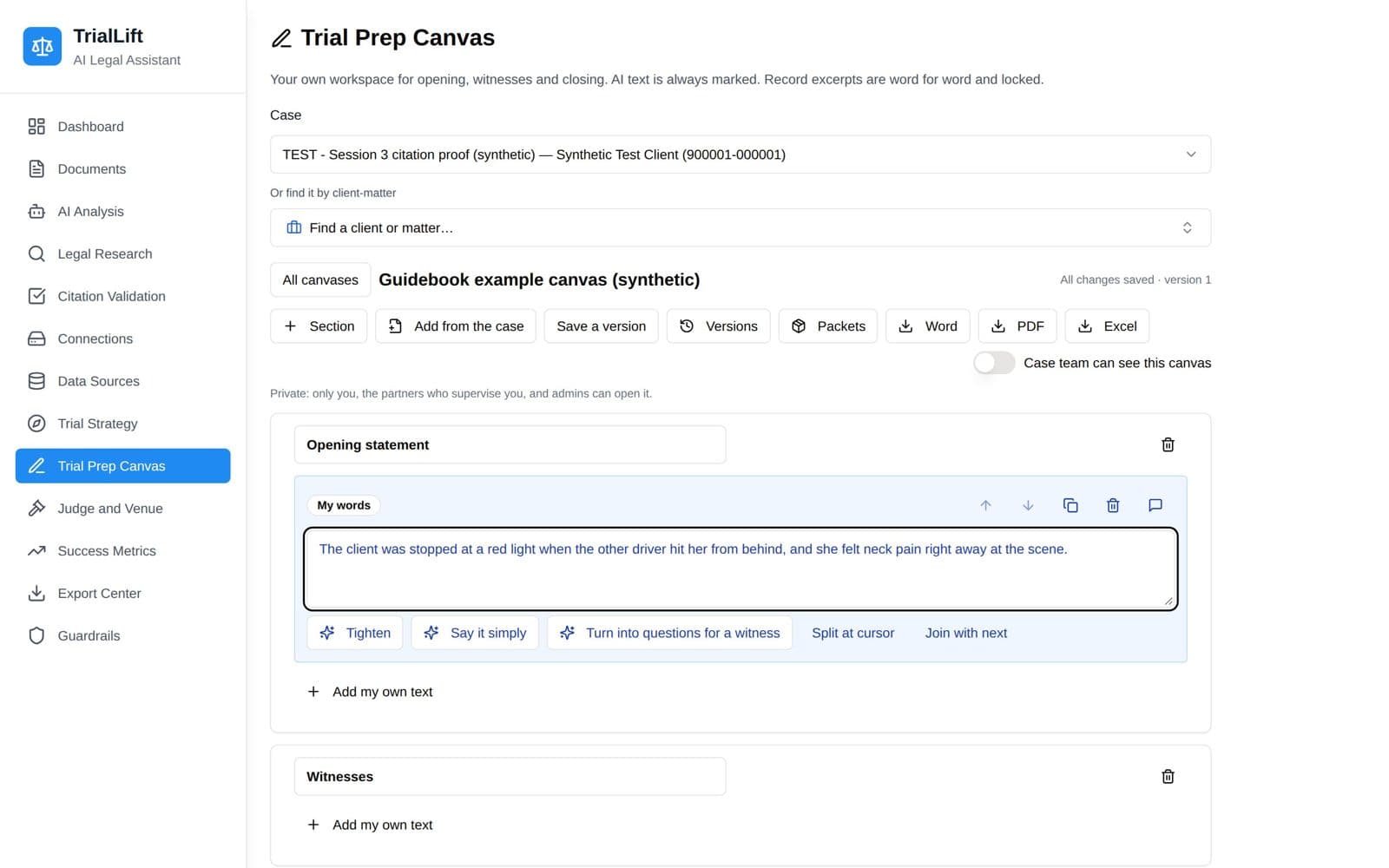
How trial prep works in TrialLift
Step 1
Bring the whole file together
Depositions, medical records, exhibits, pleadings, emails and images all live in one place for each case. Upload files or a whole folder, or connect Clio and the matter's documents come in on their own. TrialLift reads every page, scans included.
Step 2
Ask it questions and get a summary
Search the whole file in under a second. Ask for a summary across documents, the trends in the medical records, or the arguments for your client. Every statement points to the page it came from, and anything that can't be confirmed is set aside.
Step 3
Prepare in the Trial Prep Canvas
Open the Canvas and build your opening, witnesses, exhibits, cross-examination and closing. Add your own notes, pull in verified excerpts with their pages, and turn notes into witness questions. AI text is always marked, and nothing changes until you accept it.
Step 4
Plan the trial with predictive analysis
Trial Strategy scores every piece of evidence for completeness, ranks the gaps, and proposes witness and exhibit order and opening and closing themes. Judge and Venue adds the sitting judge's background and reported verdicts for cases like yours.
Predictive analysis built on real records
The goal is a trial plan with the best odds of success, built from facts. TrialLift combines the current case with the record around it: your firm's own history of similar cases, the sitting judge, opposing counsel, and how comparable cases have actually come out.
Working today
Evidence completeness scores, ranked gaps with what to get next, a High, Medium or Low outlook set by a written rule with its reasons, a proposed trial plan, the judge's public background, and reported New York verdicts and settlements with their sources.
Being connected next
Your firm's closed cases from its case system, verdict data that includes defense wins, the judge's motion rulings, and opposing counsel's track record. Each source switches on only once it is connected and has enough real cases behind it.
TrialLift shows real counts with their sources. It never makes up a win percentage.
Four promises TrialLift keeps
General AI tools can write citations that do not exist, and courts have sanctioned lawyers for filing them. You can see every reported case in the AI Hallucination Cases database. These rules are enforced by the software and written into the guidebook every user receives.
- It never invents a number.
- If something has not been recorded, TrialLift says "Not recorded yet" instead of guessing.
- Every AI statement points to a page.
- Each statement is checked against the page it cites before you see it. Anything that cannot be confirmed is set aside and never reaches a review or an export.
- Client names stay inside the firm.
- Names and identifiers are swapped for placeholders before anything goes to an AI, then put back in the answer.
- Everything is on the record.
- Uploads, AI uses, edits, approvals and downloads are all logged, and the logs show if anyone tampers with them.
Also built in. Citation Validation checks every citation and quote in a brief against real court records before it is filed. AI Governance records every AI use in the firm, so partners can see exactly what was asked and what came back.
Works with what your firm already uses. TrialLift connects to Clio today. Citations are checked against public court records from CourtListener and GovInfo, and only the citation is ever sent, never a client name or fact.
Three firms. Sixty days. No licensing fees.
The first 3 firms accepted into the founding pilot use TrialLift for 60 days with no licensing fees. In return, you use it on real cases and tell us plainly what works and what does not.